May 25, 2011

Back into salvia space


So I posted that psychedelics post and then went off to a meeting the implications of which I hadn't really considered. I did some cleaning the other week and found a vial of salvia left over from several years ago, when I growing / smoking a lot as a way to cut stress on a brutal split shift and ease into meditation / self-hypnosis to refresh and also blank out the dull horror of permanent work crisis and creeping personal ones ahead of finding out I could untie all knots just by gently pulling the right thread, instead of all the wrong ones, harder.


I suggested to a friend that they might want to try it, so I went over to demonstrate. They saw me inhale, lie down eyes shut, do the thirty count in my head, then pass out. They were not enthused.


I used to smoke a lot of salvia over a period of several years, and I think I mapped the territory as well as I could, devising stories that satisfied me for certain problems it raised that seemed tractable, and letting other parts – the bulk of the experience – rest easy as mysteries to be lived with.


Long / short: I went back into salvia space and it was as welcoming as that first trip seven or so years ago [“Hey........you're back!” these little corn-headed flower entities waved at me and cheered back then, the first time, third hit a charm, as I descended and rematerialized into the land of extreme waking dreams. This time everyone was going about their business and I dropped back in almost incognito, the weirdness, as ever, unfailing, but no longer an obvious tourist].


Shorter: the infantile ego was silenced, and relief was felt, and I came back smiling with forgetfulness.

May 22, 2011

The relief you can feel on a good psychedelic trip

The fantasy they’re selling [on a luxury cruise] is the whole reason why all the subjects in all the brochures’ photos have facial expressions that are at once orgasmic and oddly slack: these expressions are the facial equivalent of going “Aaaahhhhh,” and the sound is not just that of somebody’s Infantile part exulting in finally getting the total pampering it’s always wanted but also that of the relief all the other parts of that person feel when the Infantile part finally shuts up.
The best of the rest of the time just being ways of surfing the needs / wants and / or distracting them with some zen / art magic or stoic practice.

Coming off a long few weeks of intense work and waking up to a reality that I haven't found my way in yet, just suspicions that the old one isn't going to serve much longer without some changes that remain obscure.

Somewhat related:
Posts that refer to the hedonic treadmill.

May 21, 2011

I never had any plans beyond a certain lifestyle

I am now 33 years old, and it feels like much time has passed and is passing faster and faster every day. Day to day I have to make all sorts of choices about what is good and important and fun, and then I have to live with the forfeiture of all the other options those choices foreclose. And I’m starting to see how as time gains momentum my choices will narrow and their foreclosures multiply exponentially until I arrive at some point on some branch of all life’s sumptuous branching complexity at which I am finally locked in and stuck on one path and time speeds me through stages of stasis and atrophy and decay until I go down for the third time, all struggle for naught, drowned by time. It is dreadful. But since it’s my own choices that’ll lock me in, it seems unavoidable—if I want to be any kind of grownup, I have to make choices and regret foreclosures and try to live with them.

May 19, 2011

For the way the rich live

karl lagerfeld - pirelli
I personally only like high-class escorts. I don’t like sleeping with people I really love. I don’t want to sleep with them because sex cannot last, but affection can last forever. I think this is healthy. And for the way the rich live, this is possible. But the other world, I think they need porn.
Karl Lagerfeld, Vice interview

May 12, 2011

Scale variance

What I hope to demonstrate is that each way of thinking has its proper place and a specific, pragmatic scope, within which it makes sense.
Related:
The imperatives of survival on six distinct time scales
Turtles all the way

May 11, 2011

Towards a Transformative Hermeneutics of Quantum Gravity

No doubt there exist thoughts so profound that most of us will not understand the language in which they are expressed. And no doubt there is also language designed to be unintelligible in order to conceal an absence of honest thought. But how are we to tell the difference?
Postmodernism Disrobed by Richard Dawkins
Related: Some posts on the Sokal Hoax

May 09, 2011

As a man thinketh in his heart, so is he

But of all his myriad past experiences and encounters, Greg [Dark] credited one man with teaching him the most important lesson of his life. He met his teacher in the early ’70s on the tennis courts at Stanford. During certain hours of the week, the courts were open to the public. According to Greg, a man showed up one morning driving a garishly painted Cadillac. He wore a peacock-feather hat and an ankle-length fur coat, which he slipped off to reveal standard tennis whites. The man was a street pimp from Oakland. Greg and the pimp became friends on and off the court. In Greg‘s personal lore, the pimp taught him the essentials of the “whore con”:

A) Men are powerless before the lure of female sexuality.

B) The whore lures men by promising unlimited sexual fulfillment.

C) As soon as she has lured a man and has begun to extract payment, the whore withholds as much sex as she can get away with.

D) The whore understands that the more she withholds, the greater her value.

E) All women are whores.

After dropping out of therapy, I increasingly turned to Greg for personal guidance.

May 05, 2011

Another sign of my lack of imagination

from here
Larkin's life was a failure; his work was a triumph. That is all that matters. Because the work, unlike the life, lives on.

I don't see how this view is possible without an idea of an afterlife I don't have. Life is all that matters.

Related: ...

May 03, 2011

Back from making a new life

Dear Bernard-Henri Levy,

We have, as they say, nothing in common except for one essential trait: we are both rather contemptible individuals.

A specialist in farcical media stunts, you dishonor even the white shirts you always wear. An intimate of the powerful who, since childhood, has wallowed in obscene wealth, you are the epitome of what certain slightly tawdry magazines like Marianne still call 'champagne socialism' and what German journalists more astutely refer to as the Toskana-Fraktion. A philosopher without an original idea but with excellent contacts, you are, in addition, the creator behind the most preposterous film in the history of cinema.

Nihilist, reactionary, cynic, racist, shameless misogynist: to lump me in with the rather unsavory family of right-wing anarchists would be to give me too much credit; basically, I'm just a redneck. An unremarkable author with no style, I achieved literary notoriety some years ago as the result of an uncharacteristic error in judgment by critics who had lost the plot. Happily, my heavy-handed provocations have since fallen from favor.

Together, we perfectly exemplify the shocking dumbing-down of French culture and intellect as was recently pointed out, sternly but fairly, by Time magazine.

We have contributed nothing to the electro-pop revival in France. We're not even mentioned in the credits of Ratatouille.

These then are the terms of the debate.
Michel Houellebecq's first letter to Bernard-Henri Levy in Public Enemies

March 13, 2011

No comment

If the work is good, what you say about it is usually irrelevant.

February 22, 2011

You are what you read

...reading a great work for the first time when one is fully adult is an extraordinary pleasure, one which is very different (though it is impossible to say whether more or less pleasurable) from reading it in one's youth. Youth endows every reading, as it does every experience, with a unique flavour and significance, whereas at a mature age one appreciates (or should appreciate) many more details, levels and meanings. We can therefore try out this other formulation of our definition [of a classic]:

2. The classics are those books which constitute a treasured experience for those who have read and loved them; but they remain just as rich an experience for those who reserve the chance to read them for when they are in the best condition to enjoy them.

For the fact is that the reading we do when young can often be of little value because we are impatient, cannot concentrate, lack expertise in how to read, or because we lack experience of life. This youthful reading can be (perhaps at the same time) literally formative in that it gives a form or shape to our future experiences, providing them with models, ways of dealing with them, terms of comparison, schemes for categorising them, scales of value, paradigms of beauty: all things which continue to operate in us even when we remember little or nothing about the book we read when young. When we reread the book in our maturity, we then rediscover these constants which by now form part of our inner mechanisms though we have forgotten where they came from. There is a particular potency in the work which can be forgotten in itself but which leaves its seed behind in us.
Italo Calvino, Why Read the Classics?

February 19, 2011

Evidence that takes some sorting

A typical assignment for Srivastava goes like this: A mining company has multiple samples from a potential gold mine. Each sample gives a different estimate of the amount of mineral underground. “My job is to make sense of those results,” he says. “The numbers might seem random, as if the gold has just been scattered, but they’re actually not random at all. There are fundamental geologic forces that created those numbers. If I know the forces, I can decipher the samples. I can figure out how much gold is underground.”

February 17, 2011

The 3lb Universe

The strange truth about reality is that it is both objective and subjective. In one sense we are totally at the mercy of the forces of reality, and in another sense we create our own image of reality and impose our own will on reality. One paradox revealed by psychedelics is that reality creates the mind which creates the illusion of reality so that reality can organize, observe, and modify itself from a variety of novel subjective perspectives. I think that psychedelic paradigms of god, unity, latent psychic powers, and cosmic consciousness are all attempts to grapple with the cosmic scope of this mind-bending paradox where object and subject dissolve into the same thing looking back at itself across the expanding sea of infinity. Human brains are not meant to cope with this inverted universal perspective of reality; we have no good words for encompassing the experience; the common name we use is God.

February 11, 2011

Sorting through notes on blank business cards, getting things back together again


Not sure when/where, but a note from a talk by Karl Shroeder where he said something like: There are no disruptive technologies, only disruptive business plans.

February 10, 2011

A nonabstract continuation of reality

The cybernetic structure of a person has been refined by a very large, very long, and very deep encounter with physical reality.
...
From this point of view, what can make bits have meaning is that their patterns have been hewn out of so many encounters with reality that they aren't really abstractable bits anymore, but are instead a nonabstract continuation of reality.

February 08, 2011

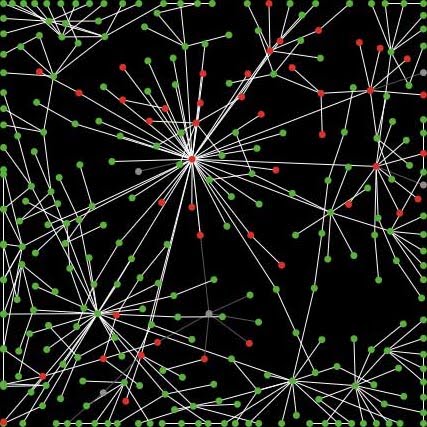
Using Power Laws to Predict Terrorist Attacks

image from this page about ponzi schemes
“It is weird when you step back and say, ‘There are thinking, social beings in these organizations, they have families and causes and ideals and so on.’ And I’m thinking about them as being a little bit like particles.

“But,” he says, “the patterns speak for themselves.”

February 06, 2011

Surounded by practical infinities

I awaked each morning in a fever, sometimes frantically trying to verify or discredit such information as fell within the range of modern human knowledge. Traditional facts took on new and doubtful aspects, and I marvelled at the dream-fancy which could invent such surprising addenda to history and science. I shivered at the mysteries the past may conceal, and trembled at the menaces the future may bring forth. What was hinted in the speech of post-human entities of the fate of mankind produced such an effect on me that I will not set it down here.
H.P Lovecraft, The Shadow Out of Time

February 04, 2011

Drinking [of limited interest]


I spent the summer when I was 19 working at a summer camp in the US, and that was a dry season, but in the 21 yrs since then I don't think I've gone any less than 3 days out of 5 without a drink, and more often 14 in 15.

I stopped last week [1/26], other than a small glass of beer socially if we go out for dinner, and things were good, other than being at a loss what to drink at night and having too much energy and focus in the evenings. And fortunately I live in a place and move in circles where weed is hard to find and expensive.

As a weakness / test of the system I drank again last night [2.25L of beer] with the predicted results, but then stopped there, rather than moving on to something else. It was interesting to see how clear it is where the problem lies, and so back to no drinking again.

January 28, 2011

Oral/anal

"You don't get it. I am one runaway son of a bitch! I am an animal! I want to eat everything! I want to get drunk every single night! I want to screw every woman there is! We are all wild animals. But we must learn to use our minds. We must learn to control the bestial and sensual sides of ourselves!"

January 21, 2011

Working hypotheses

Perhaps it would be better if I could find one single philosophy that I could apply equally to each circumstance, but I find that the best path is to believe different things about aspects of reality when I play these different roles or perform different duties.
Related posts:
The imperatives of survival on six distinct time scales
Turtles all the way

January 19, 2011

Meanwhile, on the other side of the firewall...

Younger Chinese friends of mine regard the firewall as they would an officious lifeguard at a swimming pool—an occasional, largely irrelevant, intrusion.

To get around it, Tang detours through a proxy server—a digital way station overseas that connects a user with a blocked Web site. He watches television exclusively online, because he doesn’t have a TV in his room. Tang also receives foreign news clips from Chinese students abroad. (According to the Institute of International Education, the number of Chinese students in the United States—some sixty-seven thousand—has grown by nearly two-thirds in the past decade.) He’s baffled that foreigners might imagine that people of his generation are somehow unwise to the distortions of censorship.

“Because we are in such a system, we are always asking ourselves whether we are brainwashed,” he said. “We are always eager to get other information from different channels.” Then he added, “But when you are in a so-called free system you never think about whether you are brainwashed.”

The New Yorker. Angry Youth - The new generation’s neocon nationalists [in China].


January 17, 2011

The orderly management of decline in my youth

As the mid-seventies progressed, this pessimism about the economy spread far beyond the City of London. In 1977, New Society compared the results of two large-scale professional surveys of Britons' financial situations and expectations, one recent and one four years earlier. The magazine found that the percentage of people expecting their standard of living to 'fall sharply' in the next ten years had more than doubled, overtaking the proportion of Britons expecting things to improve or stay the same. It also found that most people's sense of their current 'material position' had dramatically w0orsened. In 1973, 18 per cent of those surveyed had considered their position very strong. In 1977, the figure was 5 per cent. In 1973, only 13 per cent had regarded their position as very weak. In 1977, it was 26 per cent.

These perceptions were broadly accurate.
Andy Beckett, When the Lights Went Out, p176.

January 15, 2011

Assured sex and an explosion of creativity

In the wild, songs probably had to be rigid in order for mates to find each other. Birds born with a genetic predilection for musical innovation most likely would have had trouble mating. Once finches [in captivity] experienced the luxury of assured mating (provided they were visually attractive), their song variety exploded.

January 11, 2011

Passive resistance to radical overcompensation

What they [terrorist fundamentalists] lack is a feature that is to discern in all authentic fundamentalists, from Tibetan Buddhists to the Amish in the US: the absence of resentment and envy, the deep indifference towards the non-believers' way of life. If today's so-called fundamentalists really believe they have found their way to truth, why should they feel threatened by non-believers, why should they envy them? When a Buddhist encounters a Western hedonist, he hardly condemns him. He just benevolently notes that the hedonist's search for happiness is self-defeating. In contrast to true fundamentalists, the terrorist pseudo-fundamentalists are deeply bothered, intrigued, fascinated by the sinful life of non-believers. One can feel that, in fighting the sinful Other, they are fighting their own temptation. These so-called Christian or Muslim fundamentalists are a disgrace to true fundamentalism.
Slavoj Zizek, In Defense of Lost Causes, p 332

January 09, 2011

Words of advice


Don't say thank-you or sorry after sex.