Showing posts with label networks. Show all posts

February 08, 2011

Using Power Laws to Predict Terrorist Attacks

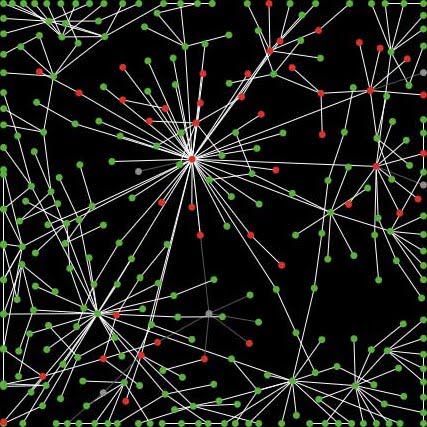
image from this page about ponzi schemes
“It is weird when you step back and say, ‘There are thinking, social beings in these organizations, they have families and causes and ideals and so on.’ And I’m thinking about them as being a little bit like particles.

“But,” he says, “the patterns speak for themselves.”

October 18, 2009

Traces of thought

A computer simulation of the upper layer of a rat brain neocortical column. Dr. Pablo de Heras Ciechomski/Visualbiotech

These images, and their captions, come from an article introducing a project to simulate part of a rat's brain, to be scaled up to a whole brain and later put into a robot with legs. Excerpts below, full link at the bottom.
In the basement of a university in Lausanne, Switzerland sit four black boxes, each about the size of a refrigerator, and filled with 2,000 IBM microchips stacked in repeating rows.
...
This is Blue Brain. The name of the supercomputer is literal: Each of its microchips has been programmed to act just like a real neuron in a real brain. The behavior of the computer replicates, with shocking precision, the cellular events unfolding inside a mind.
...
The first phase of the project—“the feasibility phase”—is coming to a close. The skeptics, for the most part, have been proven wrong. It took less than two years for the Blue Brain supercomputer to accurately simulate a neocortical column, which is a tiny slice of brain containing approximately 10,000 neurons, with about 30 million synaptic connections between them.
...
In fact, the model is so successful that its biggest restrictions are now technological. “We have already shown that the model can scale up,” Markram says. “What is holding us back now are the computers.” The numbers speak for themselves. Markram estimates that in order to accurately simulate the trillion synapses in the human brain, you’d need to be able to process about 500 petabytes of data (peta being a million billion, or 10 to the fifteenth power). That’s about 200 times more information than is stored on all of Google’s servers.
...
“There’s no reason why you can’t get inside Blue Brain,” Markram says. “Once we can model a brain, we should be able to model what every brain makes. We should be able to experience the experiences of another mind.”
...
“There is nothing inherently mysterious about the mind or anything it makes,” Markram says. “Consciousness is just a massive amount of information being exchanged by trillions of brain cells. If you can precisely model that information, then I don’t know why you wouldn’t be able to generate a conscious mind.”
Full article at seedmagazine.com

An entire neocortical column lights up with electrical activity. Modeled on a two-week-old rodent brain, this 0.5 mm by 2 mm slice is the basic computational unit of the brain and contains about 10,000 neurons. Visualbiotech.

Related post: Other substrates

June 01, 2009

Ways of seeing


One of the most fascinating aspects of the birth of a new science is the new language it creates, allowing us to casually converse about ideas and issues that we were struggling to describe before.
Aside from the obvious sensory disarrangement, the main component of the psychedelic experience for me is a shift in perspective, a way seeing familiar things in a different light. One other way to do this is to read / listen as widely as possible. For example, you can go into a restaurant and trip out on:
  • The taste, smell and texture of the food.
  • The sense memories the meal engenders.
  • The provenance of each ingredient.
  • The chemical processes involved in their preparation.
  • The physical processes of eating and digestion.
  • The nutritional content of the food.
  • The social dynamics between the people in the restaurant.
  • The financial side of the business.
  • How the place fits into the neighborhood.
  • ...and so on.
All these things are floating around, different ways to talk about the same thing, and the richness of the experience seems to be in sometimes surrendering to one view and letting it take you as far as it can, and other times being easily distracted, taking a more comprehensive look at aspects that you mostly ignore.

Related posts:
Why I go out drinking more often than before
Mundane in one group
A continuous network of critical states

coop - mickey finn

May 07, 2009

Why I go out drinking more often than before

The major implication intended by this paper is that the personal experience of individuals is closely bound up with larger-scale aspects of social structure, well beyond the purview or control of particular individuals. Linkage of micro and macro levels is thus no luxury, but of central importance to the development of sociological theory. Such linkage generates paradoxes: weak ties, often denounced as generative of alienation are here seen as indispensable to individuals' opportunities and to their integration into communities; strong ties, breeding social cohesion, lead to overall fragmentation. Paradoxes are a welcome antidote to theories which explain everything too neatly.
Mark Granovetter, The Strength of Weak Ties [pdf, 1973]

Click for a bigger version of an awesome 'map of science' from this paper

An idea mundane in one group can be a valuable insight in another.
Ronald S Burt, Structural Holes and Good Ideas [pdf]

April 12, 2009

Mundane in one group

In proportion to the development of his individuality, each person becomes more valuable to himself, and is therefore capable of being valuable to others. There is a greater fullness of life about his own existence, and when there is more life in the units there is more in the mass, which is composed of them.
JS Mill On Liberty
People whose networks span structural holes have early access to diverse, often contradictory, information and interpretations which gives them a good competitive advantage in delivering good ideas. People connected to groups beyond their own can expect to find themselves delivering valuable ideas, seeming to be gifted with creativity. This is not creativity born of deep intellectual ability. It is creativity as an import-export business. An idea mundane in one group can be a valuable insight in another.
Ronald S Burt, Structural Holes and Good Ideas [pdf]

October 07, 2008

A continuous network of critical states

In a self-organized critical state, the fall of a single grain of sand on to the network may trigger a large-scale rearrangement of the [pile of] sand; but after this rearrangement has occurred there will still be a complex network of critical states, it will just be arranged in a different pattern.
John Gribbin, Deep Simplicity, p163
I think I'll quit my job in December and go full-time freelance and see if I can't ride without a boss until the end of my days [currently aiming for 90+, without a Singularity] .

My only problem with relying on proofreading is the same as its basic appeal - that I can set my own hours. At the moment I keep evening classes as training wheels to ensure that I a) get dressed, leave the house and talk to people I'm not married to / buying things from at least once a day, and b) don't start drinking before 10pm. I took the wheels off in 1997 for one year in China and the results were fun, but somewhat alarming.

Still, I was someone else then.