
If the work is good, what you say about it is usually irrelevant.Stanley Kubrick - Rolling Stone interview 1987
If the work is good, what you say about it is usually irrelevant.Stanley Kubrick - Rolling Stone interview 1987

...reading a great work for the first time when one is fully adult is an extraordinary pleasure, one which is very different (though it is impossible to say whether more or less pleasurable) from reading it in one's youth. Youth endows every reading, as it does every experience, with a unique flavour and significance, whereas at a mature age one appreciates (or should appreciate) many more details, levels and meanings. We can therefore try out this other formulation of our definition [of a classic]:
2. The classics are those books which constitute a treasured experience for those who have read and loved them; but they remain just as rich an experience for those who reserve the chance to read them for when they are in the best condition to enjoy them.
For the fact is that the reading we do when young can often be of little value because we are impatient, cannot concentrate, lack expertise in how to read, or because we lack experience of life. This youthful reading can be (perhaps at the same time) literally formative in that it gives a form or shape to our future experiences, providing them with models, ways of dealing with them, terms of comparison, schemes for categorising them, scales of value, paradigms of beauty: all things which continue to operate in us even when we remember little or nothing about the book we read when young. When we reread the book in our maturity, we then rediscover these constants which by now form part of our inner mechanisms though we have forgotten where they came from. There is a particular potency in the work which can be forgotten in itself but which leaves its seed behind in us.Italo Calvino, Why Read the Classics?
A typical assignment for Srivastava goes like this: A mining company has multiple samples from a potential gold mine. Each sample gives a different estimate of the amount of mineral underground. “My job is to make sense of those results,” he says. “The numbers might seem random, as if the gold has just been scattered, but they’re actually not random at all. There are fundamental geologic forces that created those numbers. If I know the forces, I can decipher the samples. I can figure out how much gold is underground.”

The strange truth about reality is that it is both objective and subjective. In one sense we are totally at the mercy of the forces of reality, and in another sense we create our own image of reality and impose our own will on reality. One paradox revealed by psychedelics is that reality creates the mind which creates the illusion of reality so that reality can organize, observe, and modify itself from a variety of novel subjective perspectives. I think that psychedelic paradigms of god, unity, latent psychic powers, and cosmic consciousness are all attempts to grapple with the cosmic scope of this mind-bending paradox where object and subject dissolve into the same thing looking back at itself across the expanding sea of infinity. Human brains are not meant to cope with this inverted universal perspective of reality; we have no good words for encompassing the experience; the common name we use is God.

Not sure when/where, but a note from a talk by Karl Shroeder where he said something like: There are no disruptive technologies, only disruptive business plans.

The cybernetic structure of a person has been refined by a very large, very long, and very deep encounter with physical reality.
...
From this point of view, what can make bits have meaning is that their patterns have been hewn out of so many encounters with reality that they aren't really abstractable bits anymore, but are instead a nonabstract continuation of reality.Jaron Lanier, You are not a Gadget: A Manifesto
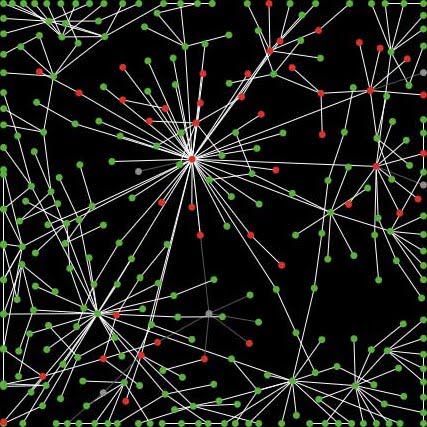 image from this page about ponzi schemes
“It is weird when you step back and say, ‘There are thinking, social beings in these organizations, they have families and causes and ideals and so on.’ And I’m thinking about them as being a little bit like particles.
“But,” he says, “the patterns speak for themselves.”
I awaked each morning in a fever, sometimes frantically trying to verify or discredit such information as fell within the range of modern human knowledge. Traditional facts took on new and doubtful aspects, and I marvelled at the dream-fancy which could invent such surprising addenda to history and science. I shivered at the mysteries the past may conceal, and trembled at the menaces the future may bring forth. What was hinted in the speech of post-human entities of the fate of mankind produced such an effect on me that I will not set it down here.H.P Lovecraft, The Shadow Out of Time

I spent the summer when I was 19 working at a summer camp in the US, and that was a dry season, but in the 21 yrs since then I don't think I've gone any less than 3 days out of 5 without a drink, and more often 14 in 15.
I stopped last week [1/26], other than a small glass of beer socially if we go out for dinner, and things were good, other than being at a loss what to drink at night and having too much energy and focus in the evenings. And fortunately I live in a place and move in circles where weed is hard to find and expensive.
As a weakness / test of the system I drank again last night [2.25L of beer] with the predicted results, but then stopped there, rather than moving on to something else. It was interesting to see how clear it is where the problem lies, and so back to no drinking again.
"You don't get it. I am one runaway son of a bitch! I am an animal! I want to eat everything! I want to get drunk every single night! I want to screw every woman there is! We are all wild animals. But we must learn to use our minds. We must learn to control the bestial and sensual sides of ourselves!"

Perhaps it would be better if I could find one single philosophy that I could apply equally to each circumstance, but I find that the best path is to believe different things about aspects of reality when I play these different roles or perform different duties.Related posts:Jaron Lanier, You are not a Gadget: A Manifesto

Younger Chinese friends of mine regard the firewall as they would an officious lifeguard at a swimming pool—an occasional, largely irrelevant, intrusion.To get around it, Tang detours through a proxy server—a digital way station overseas that connects a user with a blocked Web site. He watches television exclusively online, because he doesn’t have a TV in his room. Tang also receives foreign news clips from Chinese students abroad. (According to the Institute of International Education, the number of Chinese students in the United States—some sixty-seven thousand—has grown by nearly two-thirds in the past decade.) He’s baffled that foreigners might imagine that people of his generation are somehow unwise to the distortions of censorship.
“Because we are in such a system, we are always asking ourselves whether we are brainwashed,” he said. “We are always eager to get other information from different channels.” Then he added, “But when you are in a so-called free system you never think about whether you are brainwashed.”
The New Yorker. Angry Youth - The new generation’s neocon nationalists [in China].

As the mid-seventies progressed, this pessimism about the economy spread far beyond the City of London. In 1977, New Society compared the results of two large-scale professional surveys of Britons' financial situations and expectations, one recent and one four years earlier. The magazine found that the percentage of people expecting their standard of living to 'fall sharply' in the next ten years had more than doubled, overtaking the proportion of Britons expecting things to improve or stay the same. It also found that most people's sense of their current 'material position' had dramatically w0orsened. In 1973, 18 per cent of those surveyed had considered their position very strong. In 1977, the figure was 5 per cent. In 1973, only 13 per cent had regarded their position as very weak. In 1977, it was 26 per cent.
These perceptions were broadly accurate.Andy Beckett, When the Lights Went Out, p176.
In the wild, songs probably had to be rigid in order for mates to find each other. Birds born with a genetic predilection for musical innovation most likely would have had trouble mating. Once finches [in captivity] experienced the luxury of assured mating (provided they were visually attractive), their song variety exploded.Jaron Lanier, You are not a Gadget: A Manifesto
What they [terrorist fundamentalists] lack is a feature that is to discern in all authentic fundamentalists, from Tibetan Buddhists to the Amish in the US: the absence of resentment and envy, the deep indifference towards the non-believers' way of life. If today's so-called fundamentalists really believe they have found their way to truth, why should they feel threatened by non-believers, why should they envy them? When a Buddhist encounters a Western hedonist, he hardly condemns him. He just benevolently notes that the hedonist's search for happiness is self-defeating. In contrast to true fundamentalists, the terrorist pseudo-fundamentalists are deeply bothered, intrigued, fascinated by the sinful life of non-believers. One can feel that, in fighting the sinful Other, they are fighting their own temptation. These so-called Christian or Muslim fundamentalists are a disgrace to true fundamentalism.Slavoj Zizek, In Defense of Lost Causes, p 332

...it’s true that I really wanted to make money so that I could quit my job. That’s the only point of having money, to have the freedom of your days, but it’s fundamental.Michel Houellebecq, Paris Review interview

Whenever we notice an instance when history was swayed by accident, we also notice the latitude we have to shape the future.Jaron Lanier, You are not a Gadget: A Manifesto

Perhaps the solution begins from softly accepting chaos not as something that “should not be there,” to be rejected fundamentally in principle, but as something that “is there in actual fact.”Haruki Murakami, Reality A and Reality B
"Everyone now has the chance to choose the part which he will play in the film of a hundred years hence," Goebbels told his staff at the propaganda Ministry on April 17 [1945], inspired by the Third Reich's last cinematic feat, Kolberg, and epic depiction of that town's last-ditch defence during the Napoleonic Wars. "I can assure you that it will be a fine and elevating picture...Hold out now, so that...the audience does not hoot and whistle when appear on the screen." Thus was the Third Reich to go down: in an inglorious blaze.Niall Ferguson, The War of the World

You know your job. Work hard to quash other men and render them sterile. Dream enormous dreams and seek women. Many men do this. You do it with unique verve and efficacy. Now you're 61 and waiting in the dark for another married mother to call you. Isn't that pathetic? Aren't you ashamed? No, not really.James Ellroy, The Hillicker Curse: My pursuit of women

We are going to die, and that makes us the lucky ones. Most people are never going to die because they are never going to be born. The potential people who could have been here in my place but who will in fact never see the light of day outnumber the sand grains of the Sahara. Certainly those unborn ghosts include greater poets than Keats, scientists greater than Newton. We know this because the set of possible people allowed by our DNA so massively outnumbers the set of actual people. In the teeth of these stupefying odds it is you and I, in our ordinariness, that are here.Richard Dawkins, Unweaving the Rainbow

Opportunists move on.James Ellroy, The Hillicker Curse: My pursuit of women
The real secret behind top athletes’ genius, then, may be as esoteric and obvious and dull and profound as silence itself. The real, many-veiled answer to the question of just what goes through a great player’s mind as he stands at the center of hostile crowd-noise and lines up the free-throw that will decide the game might well be: nothing at all.
How can great athletes shut off the Iago-like voice of the self? How can they bypass the head and simply and superbly act? How, at the critical moment, can they invoke for themselves a cliché as trite as “One ball at a time” or “Gotta concentrate here,” and mean it, and then do it? Maybe it’s because, for top athletes, clichés present themselves not as trite but simply as true, or perhaps not even as declarative expressions with qualities like depth or triteness or falsehood or truth but as simple imperatives that are either useful or not and, if useful, to be invoked and obeyed and that’s all there is to it.
What if, when Tracy Austin writes that after her 1989 car crash, “I quickly accepted that there was nothing I could do about it,” the statement is not only true but exhaustively descriptive of the entire acceptance process she went through? Is someone stupid or shallow because she can say to herself that there’s nothing she can do about something bad and so she’d better accept it, and thereupon simply accept it with no more interior struggle? Or is that person maybe somehow natively wise and profound, enlightened in the childlike way some saints and monks are enlightened?
This is, for me, the real mystery—whether such a person is an idiot or a mystic or both and/or neither. The only certainty seems to be that such a person does not produce a very good prose memoir. That plain empirical fact may be the best way to explain how Tracy Austin’s actual history can be so compelling and important and her verbal account of that history not even alive. It may also, in starting to address the differences in communicability between thinking and doing and between doing and being, yield the key to why top athletes’ autobiographies are at once so seductive and so disappointing for us readers. As is so often SOP with the truth, there’s a cruel paradox involved. It may well be that we spectators, who are not divinely gifted as athletes, are the only ones able truly to see, articulate, and animate the experience of the gift we are denied. And that those who receive and act out the gift of athletic genius must, perforce, be blind and dumb about it—and not because blindness and dumbness are the price of the gift, but because they are its essence.
David Foster Wallace, "How Tracy Austin Broke My Heart" in Consider the Lobster

[Lawrance Timothy] Ryan listed the four criteria that define greatness in any artist:
- They are excellent craftsmen.
- They are innovators—they do something that no one has done before.
- They are “on trend,” as he put it—their innovations are perceived to be of value; people buy their stuff; they aren’t tragic and misunderstood, appreciated for their innovations after they’re dead.
- They are influential—others begin to do what they started.
Michael Ruhlman, The Reach of a Chef: Beyond the Kitchen


