
Awesome heroes stuck in mediocre lives are compelling, because they suggest that having a mediocre life may not be your fault.Steve Hely - How I Became a Famous Novelist
“I believe that my brain chemistry has changed as a result of this, mostly for the better. I am sated. I am complete in this environment. This is the environment I needed in order to become what I needed to become. With the Internet, I have communication with large amounts of people, in perpetuity. Always having a new war, a new battle.”Andrew Breitbart profile in the New Yorker

...the particular merit of Western philosophy is to have placed the question of truth center stage, sacrificed everything for it, going so far as to eventually consent to a form of suicide, reducing its own scope to that of an epistemological complement. It is Nietzsche, I think, that big subtle cat, who first recognized the dangers the sciences having more or less killed off revealed truths would have on philosophy itself. But it was he, consequently, who tried to taint the search for truth with suspicion. He thereby opened up in philosophy what might be called the era of disloyalty. Because what is philosophy if it relegates the search for truth to the background? We're pretty much back to the sophists.Michel Houellebecq - Public Enemies

...the most intimate regret and the most hidden is not to have loved life.E. M. Cioran, The Book of Delusions [full text]

I'm happy if I get food, sex, exercise, reading, some creativity, sociability, and a high level of control over my own time and / or space [ideally both, but often only one, being a freelancer who needs to pay the bills].
This feels good until I meet people who are working hard with talent and luck on more focused and appealing plans that seem to offer greater prospects for overall and long-term fulfillment, and then the monkey comparisons kick in. I'm getting better at being myself – becoming a better self to be – but sometimes it's dizzying to wonder how I got here and the hacking off of other branches at an early age, with the clear hells I escaped far outnumbering any plausible better outcomes.
Almost everything that's happened to me has been a surprise, a surrender into circumstances that then coalesce around something that can be sustained for a while, or else falls apart before being recognized as anything real enough to be destroyed. And things fall apart continuously, and if they don't then I seem to destroy them.

I'm not saying that television is vulgar and dumb because the people who compose the Audience are vulgar and dumb. Television is the way it is simply because people tend to be extremely similar in their vulgar and prurient and dumb interests and wildly different in their refined and aesthetic and noble interests.David Foster Wallace, E Unibus Pluram: Television and U.S. Fiction

From an unpublished paper I'm editing:
High self-monitors tend to engage in several activities in different specialized social systems, and they will play different roles and tailor their self-presentation behaviors to suit the specialized situation, whereas low self-monitors tend to take part in many activities in the same social system, which is often homogeneous and well-suited to their personalities (Snyder & Gangestad, 1982). This shows that high self-monitors prefer to play diverse social roles in a segmented social world, while low self-monitors are more likely have more uniform oneRelated:

So I posted that psychedelics post and then went off to a meeting the implications of which I hadn't really considered. I did some cleaning the other week and found a vial of salvia left over from several years ago, when I growing / smoking a lot as a way to cut stress on a brutal split shift and ease into meditation / self-hypnosis to refresh and also blank out the dull horror of permanent work crisis and creeping personal ones ahead of finding out I could untie all knots just by gently pulling the right thread, instead of all the wrong ones, harder.
I suggested to a friend that they might want to try it, so I went over to demonstrate. They saw me inhale, lie down eyes shut, do the thirty count in my head, then pass out. They were not enthused.
I used to smoke a lot of salvia over a period of several years, and I think I mapped the territory as well as I could, devising stories that satisfied me for certain problems it raised that seemed tractable, and letting other parts – the bulk of the experience – rest easy as mysteries to be lived with.
Long / short: I went back into salvia space and it was as welcoming as that first trip seven or so years ago [“Hey........you're back!” these little corn-headed flower entities waved at me and cheered back then, the first time, third hit a charm, as I descended and rematerialized into the land of extreme waking dreams. This time everyone was going about their business and I dropped back in almost incognito, the weirdness, as ever, unfailing, but no longer an obvious tourist].
Shorter: the infantile ego was silenced, and relief was felt, and I came back smiling with forgetfulness.
The fantasy they’re selling [on a luxury cruise] is the whole reason why all the subjects in all the brochures’ photos have facial expressions that are at once orgasmic and oddly slack: these expressions are the facial equivalent of going “Aaaahhhhh,” and the sound is not just that of somebody’s Infantile part exulting in finally getting the total pampering it’s always wanted but also that of the relief all the other parts of that person feel when the Infantile part finally shuts up.The best of the rest of the time just being ways of surfing the needs / wants and / or distracting them with some zen / art magic or stoic practice.David Foster Wallace, A Supposedly Fun Thing I'll Never Do Again
I am now 33 years old, and it feels like much time has passed and is passing faster and faster every day. Day to day I have to make all sorts of choices about what is good and important and fun, and then I have to live with the forfeiture of all the other options those choices foreclose. And I’m starting to see how as time gains momentum my choices will narrow and their foreclosures multiply exponentially until I arrive at some point on some branch of all life’s sumptuous branching complexity at which I am finally locked in and stuck on one path and time speeds me through stages of stasis and atrophy and decay until I go down for the third time, all struggle for naught, drowned by time. It is dreadful. But since it’s my own choices that’ll lock me in, it seems unavoidable—if I want to be any kind of grownup, I have to make choices and regret foreclosures and try to live with them.David Foster Wallace, A Supposedly Fun Thing I'll Never Do Again
 karl lagerfeld - pirelli
I personally only like high-class escorts. I don’t like sleeping with people I really love. I don’t want to sleep with them because sex cannot last, but affection can last forever. I think this is healthy. And for the way the rich live, this is possible. But the other world, I think they need porn.Karl Lagerfeld, Vice interview

What I hope to demonstrate is that each way of thinking has its proper place and a specific, pragmatic scope, within which it makes sense.Related:Jaron Lanier, You are not a Gadget: A Manifesto
No doubt there exist thoughts so profound that most of us will not understand the language in which they are expressed. And no doubt there is also language designed to be unintelligible in order to conceal an absence of honest thought. But how are we to tell the difference?Related: Some posts on the Sokal HoaxPostmodernism Disrobed by Richard Dawkins
But of all his myriad past experiences and encounters, Greg [Dark] credited one man with teaching him the most important lesson of his life. He met his teacher in the early ’70s on the tennis courts at Stanford. During certain hours of the week, the courts were open to the public. According to Greg, a man showed up one morning driving a garishly painted Cadillac. He wore a peacock-feather hat and an ankle-length fur coat, which he slipped off to reveal standard tennis whites. The man was a street pimp from Oakland. Greg and the pimp became friends on and off the court. In Greg‘s personal lore, the pimp taught him the essentials of the “whore con”:A) Men are powerless before the lure of female sexuality.
B) The whore lures men by promising unlimited sexual fulfillment.
C) As soon as she has lured a man and has begun to extract payment, the whore withholds as much sex as she can get away with.
D) The whore understands that the more she withholds, the greater her value.
E) All women are whores.
After dropping out of therapy, I increasingly turned to Greg for personal guidance.
Dear Bernard-Henri Levy,We have, as they say, nothing in common except for one essential trait: we are both rather contemptible individuals.
A specialist in farcical media stunts, you dishonor even the white shirts you always wear. An intimate of the powerful who, since childhood, has wallowed in obscene wealth, you are the epitome of what certain slightly tawdry magazines like Marianne still call 'champagne socialism' and what German journalists more astutely refer to as the Toskana-Fraktion. A philosopher without an original idea but with excellent contacts, you are, in addition, the creator behind the most preposterous film in the history of cinema.
Nihilist, reactionary, cynic, racist, shameless misogynist: to lump me in with the rather unsavory family of right-wing anarchists would be to give me too much credit; basically, I'm just a redneck. An unremarkable author with no style, I achieved literary notoriety some years ago as the result of an uncharacteristic error in judgment by critics who had lost the plot. Happily, my heavy-handed provocations have since fallen from favor.
Together, we perfectly exemplify the shocking dumbing-down of French culture and intellect as was recently pointed out, sternly but fairly, by Time magazine.
We have contributed nothing to the electro-pop revival in France. We're not even mentioned in the credits of Ratatouille.
These then are the terms of the debate.Michel Houellebecq's first letter to Bernard-Henri Levy in Public Enemies

If the work is good, what you say about it is usually irrelevant.Stanley Kubrick - Rolling Stone interview 1987

...reading a great work for the first time when one is fully adult is an extraordinary pleasure, one which is very different (though it is impossible to say whether more or less pleasurable) from reading it in one's youth. Youth endows every reading, as it does every experience, with a unique flavour and significance, whereas at a mature age one appreciates (or should appreciate) many more details, levels and meanings. We can therefore try out this other formulation of our definition [of a classic]:
2. The classics are those books which constitute a treasured experience for those who have read and loved them; but they remain just as rich an experience for those who reserve the chance to read them for when they are in the best condition to enjoy them.
For the fact is that the reading we do when young can often be of little value because we are impatient, cannot concentrate, lack expertise in how to read, or because we lack experience of life. This youthful reading can be (perhaps at the same time) literally formative in that it gives a form or shape to our future experiences, providing them with models, ways of dealing with them, terms of comparison, schemes for categorising them, scales of value, paradigms of beauty: all things which continue to operate in us even when we remember little or nothing about the book we read when young. When we reread the book in our maturity, we then rediscover these constants which by now form part of our inner mechanisms though we have forgotten where they came from. There is a particular potency in the work which can be forgotten in itself but which leaves its seed behind in us.Italo Calvino, Why Read the Classics?
A typical assignment for Srivastava goes like this: A mining company has multiple samples from a potential gold mine. Each sample gives a different estimate of the amount of mineral underground. “My job is to make sense of those results,” he says. “The numbers might seem random, as if the gold has just been scattered, but they’re actually not random at all. There are fundamental geologic forces that created those numbers. If I know the forces, I can decipher the samples. I can figure out how much gold is underground.”

The strange truth about reality is that it is both objective and subjective. In one sense we are totally at the mercy of the forces of reality, and in another sense we create our own image of reality and impose our own will on reality. One paradox revealed by psychedelics is that reality creates the mind which creates the illusion of reality so that reality can organize, observe, and modify itself from a variety of novel subjective perspectives. I think that psychedelic paradigms of god, unity, latent psychic powers, and cosmic consciousness are all attempts to grapple with the cosmic scope of this mind-bending paradox where object and subject dissolve into the same thing looking back at itself across the expanding sea of infinity. Human brains are not meant to cope with this inverted universal perspective of reality; we have no good words for encompassing the experience; the common name we use is God.

Not sure when/where, but a note from a talk by Karl Shroeder where he said something like: There are no disruptive technologies, only disruptive business plans.

The cybernetic structure of a person has been refined by a very large, very long, and very deep encounter with physical reality.
...
From this point of view, what can make bits have meaning is that their patterns have been hewn out of so many encounters with reality that they aren't really abstractable bits anymore, but are instead a nonabstract continuation of reality.Jaron Lanier, You are not a Gadget: A Manifesto
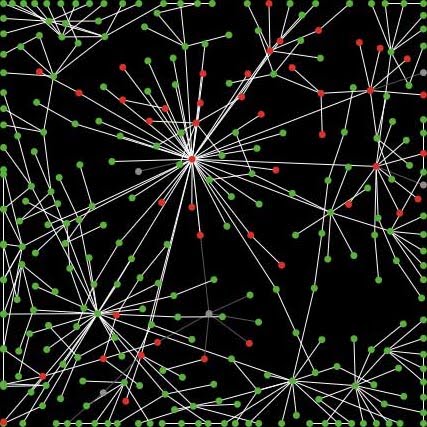 image from this page about ponzi schemes
“It is weird when you step back and say, ‘There are thinking, social beings in these organizations, they have families and causes and ideals and so on.’ And I’m thinking about them as being a little bit like particles.
“But,” he says, “the patterns speak for themselves.”
I awaked each morning in a fever, sometimes frantically trying to verify or discredit such information as fell within the range of modern human knowledge. Traditional facts took on new and doubtful aspects, and I marvelled at the dream-fancy which could invent such surprising addenda to history and science. I shivered at the mysteries the past may conceal, and trembled at the menaces the future may bring forth. What was hinted in the speech of post-human entities of the fate of mankind produced such an effect on me that I will not set it down here.H.P Lovecraft, The Shadow Out of Time

I spent the summer when I was 19 working at a summer camp in the US, and that was a dry season, but in the 21 yrs since then I don't think I've gone any less than 3 days out of 5 without a drink, and more often 14 in 15.
I stopped last week [1/26], other than a small glass of beer socially if we go out for dinner, and things were good, other than being at a loss what to drink at night and having too much energy and focus in the evenings. And fortunately I live in a place and move in circles where weed is hard to find and expensive.
As a weakness / test of the system I drank again last night [2.25L of beer] with the predicted results, but then stopped there, rather than moving on to something else. It was interesting to see how clear it is where the problem lies, and so back to no drinking again.


